



-
Posted By Dr. Ishan Shah
-
-
Comments 0

Appendicitis usually starts as a dull pain around the belly button that moves to the lower right abdomen within 12 to 24 hours and keeps getting worse. Get medical help the same day if you notice:
- Pain that moves to the lower right abdomen
- Loss of appetite
- Nausea or vomiting after the pain starts
- Low-grade fever
- Pain that worsens with coughing, walking or movement
What is an Appendix?

The appendix is a small, finger-shaped pouch attached to the first part of the large intestine, in the lower right abdomen. Its exact role is not fully understood, but you can live a completely normal life without it. When it becomes inflamed or infected, the condition is called appendicitis, and it can become serious if it is not treated in time. Early evaluation by an experienced appendix doctor in Ahmedabad helps prevent complications.
- Usually 5 to 10 cm long
- Sits in the lower right abdomen in most people
- Contains lymphoid (immune) tissue, especially active in young people
- Not essential for survival
- Appendicitis is most common between 10 and 30 years of age, but can occur at any age
- One of the most common causes of sudden abdominal pain needing surgery
What Causes Appendicitis?
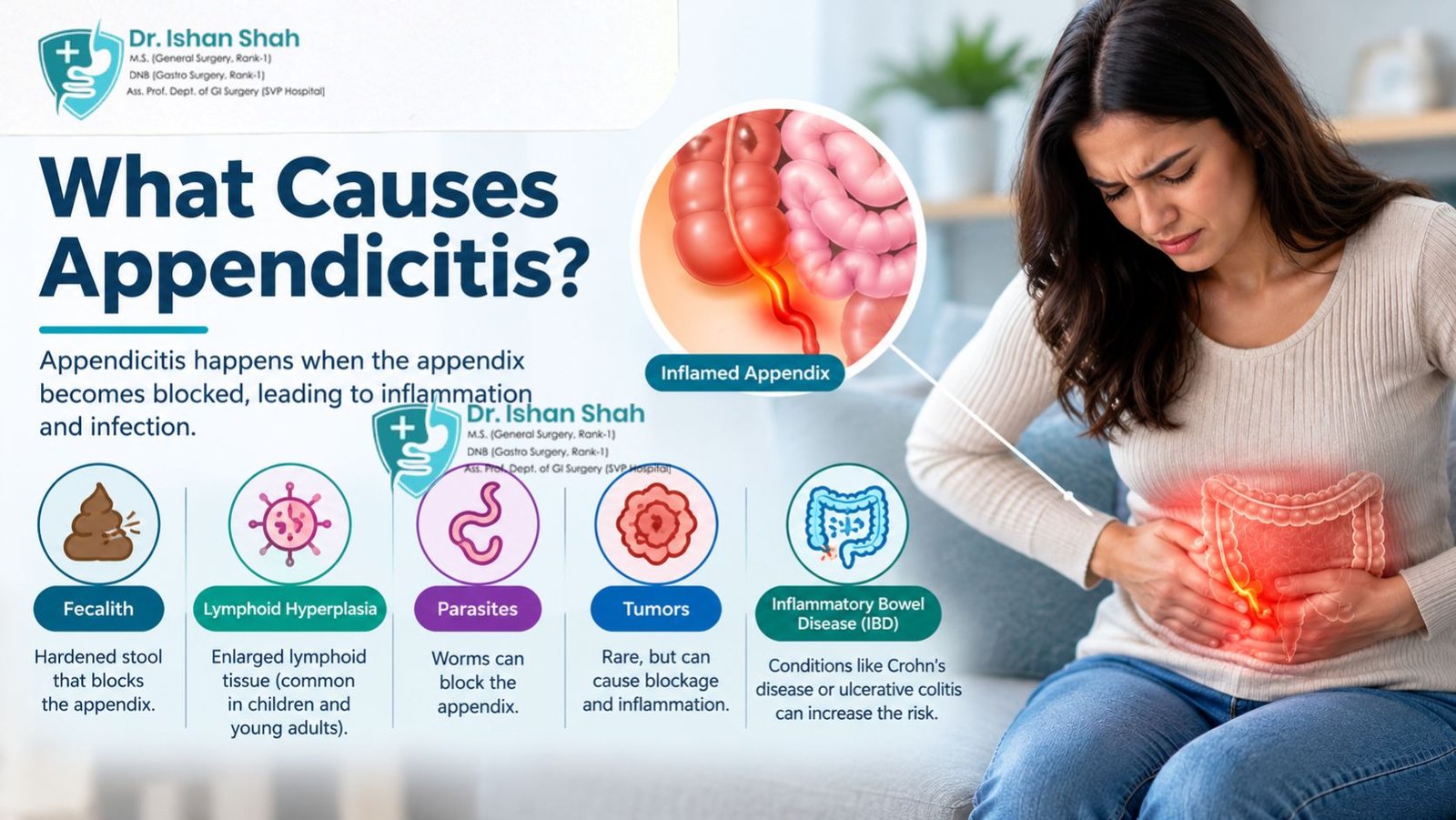
Appendicitis usually starts when the opening of the appendix gets blocked. Once blocked, mucus builds up, pressure rises, bacteria multiply and the wall swells. Without treatment, the appendix can burst. In many people, no single clear cause is found.
- Faecolith (a hardened piece of stool stuck in the opening)
- Swollen lymphoid tissue after a stomach or respiratory infection (common in children and teenagers)
- Gut infections (bacterial or viral)
- Intestinal worms or parasites (occasionally)
- Foreign material (rare)
- Tumours in or near the appendix (rare, considered more in older adults)
- Inflammatory bowel disease such as Crohn's disease
- Abdominal injury (rare)
Risk factors:
- Age 10 to 30 years
- Family history of appendicitis
- Slightly higher incidence in males
- Recent gastrointestinal or respiratory infection
- Low-fibre diet (evidence is limited)
Common myths:
- Seeds or nuts causing appendicitis are not a proven cause
- Spicy food can upset the stomach but does not cause appendicitis
- No home remedy or diet can reliably prevent it
What Side Is Your Appendix On?
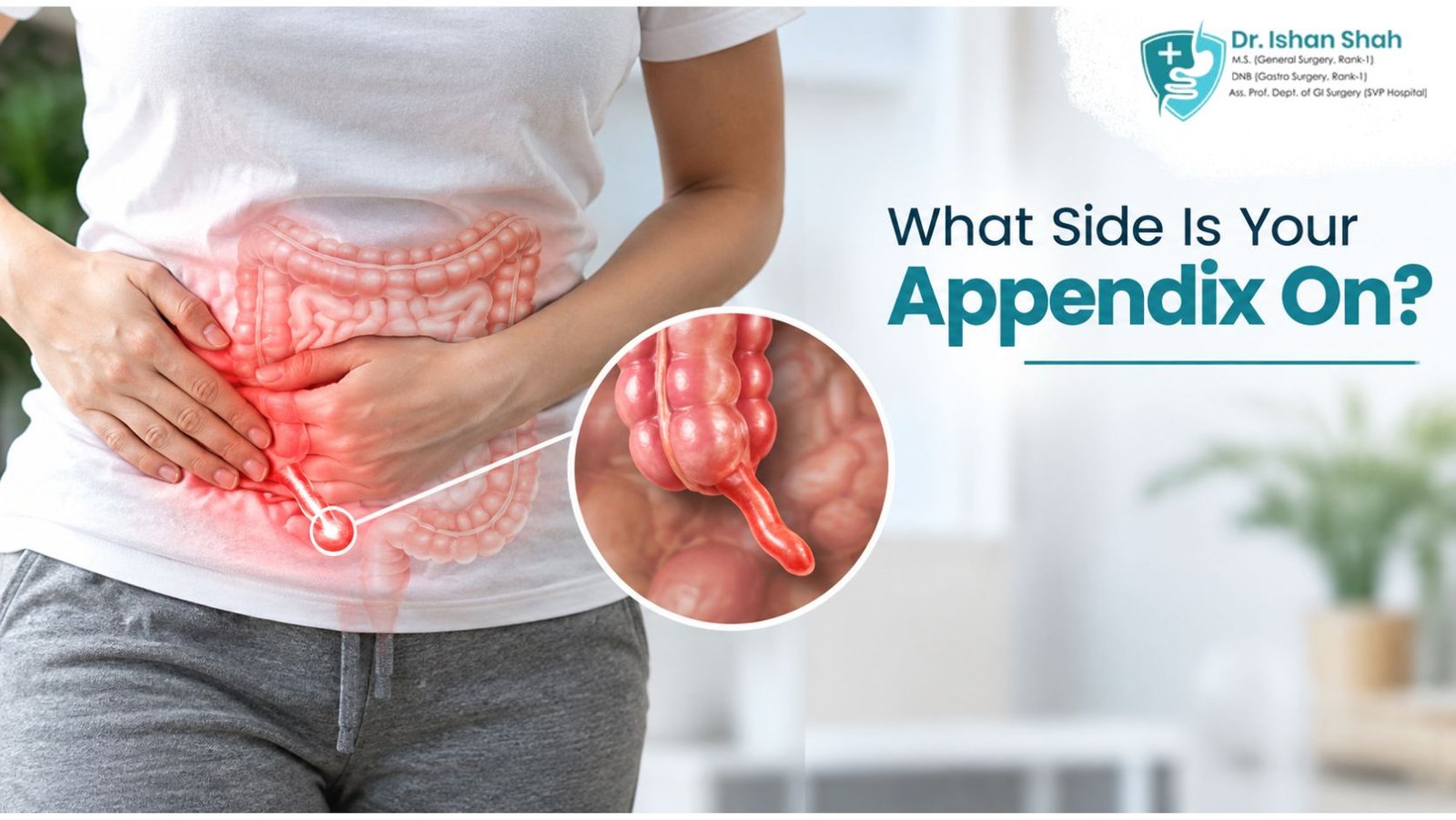
In most people, the appendix is on the lower right side of the abdomen. Doctors describe its typical location as McBurney’s point, roughly one-third of the way from the right hip bone to the belly button. Its position can vary from person to person, so the pain may not always be felt in the same spot.
- Typical position: lower right abdomen
- Behind the intestine (retrocecal): right flank or lower back
- Pelvic position: lower abdomen above the pubic bone
- High-lying position: upper right abdomen, near the liver
- During pregnancy: pushed upward, so pain is felt higher on the right
- Very rare cases (situs inversus or malrotation): appendix on the left side
The Five Main Signs of Appendicitis

Doctors look for a group of symptoms rather than a single sign. These five are the most common, and having several of them together, especially with worsening pain, is a reason to seek medical help promptly
- Moving pain: starts near the belly button and shifts to the lower right abdomen
- Loss of appetite: sudden disinterest in food
- Nausea and vomiting: usually starting after the pain
- Low-grade fever: about 99°F to 100.5°F
- Tenderness and pain with movement: worse with coughing, sneezing, walking or pressing and releasing the lower right abdomen
10 Warning Signs of Appendix Problems

Appendix problems rarely appear all at once. They build over several hours, and the pattern matters more than any single symptom. Each sign is explained below with a short description and key points.
1. Abdominal pain
Pain is the hallmark sign of appendicitis. It usually begins as a vague, dull ache near the belly button and becomes sharper as it moves to the lower right abdomen.
- Starts as dull or cramping pain around the navel
- Moves to the lower right abdomen in about 12 to 24 hours
- Becomes sharper and easier to point to with one finger
- Worsens with coughing, sneezing, deep breaths or bumps
- Many people prefer to lie still with their knees drawn up
- Steadily increasing pain is more concerning than pain that comes in waves
2. Nausea and vomiting
Nausea is very common in appendicitis. It is caused by inflammation near the intestine that irritates the digestive system
- Usually begins after the pain starts
- May be a single episode or repeated vomiting
- Vomiting that comes first and pain later suggests other causes, though this is not a strict rule
- Persistent vomiting with abdominal pain needs medical attention
3. Loss of appetite
Loss of appetite is often one of the earliest signs, sometimes appearing before the pain becomes severe.
- Sudden disinterest in food in a person who normally eats well
- Very common in both adults and children
- Should be taken seriously when combined with abdominal discomfort
4. Fever
A mild fever is the body’s response to inflammation and infection. Its pattern can give useful clues about how far the condition has progressed.
- Early appendicitis often causes a low-grade fever (99°F to 100.5°F)
- A rising fever or chills may mean the infection is spreading
- High fever with severe pain may suggest a ruptured appendix
- Some patients never develop fever, so absence of fever does not rule appendicitis out
5. Abdominal bloating and swelling
As the appendix becomes more inflamed, the digestive system slows down, which can make the abdomen feel full and tight.
- Feeling of fullness or bloating
- Difficulty passing gas or stool
- Abdomen may become tender or slightly swollen
- A hard, rigid belly is an emergency sign
6. Urinary symptoms (frequent urination)
When the inflamed appendix lies close to the bladder or ureter, it can irritate the urinary tract. This is why some people with appendicitis notice urinary changes.
- Frequent urination or urgency
- Mild burning or discomfort while passing urine
- Feeling that the bladder is not fully empty
- Can look like a urinary tract infection or kidney stone, so proper examination is needed
- Tenderness and pain with movement: worse with coughing, sneezing, walking or pressing and releasing the lower right abdomen
7. Malaise (feeling generally unwell)
Malaise is a general sense of being unwell. It is not specific to appendicitis, but it adds to the overall picture when it appears with abdominal pain.
- Tiredness and low energy
- Reduced motivation and wanting to rest
- Irritability or a sense of unease
- Mild body aches, similar to a common illness
8. Diarrhoea or constipation
Bowel habits can change when the appendix irritates the nearby intestine or rectum.
- Loose or frequent stools, especially with a pelvic appendix
- Some people get constipation or cannot pass gas
- Severe watery diarrhoea is more often from a stomach infection
- Worsening lower right abdominal pain with fever and vomiting should be evaluated
9. Back or flank pain
Back pain is a lesser-known sign, seen when the appendix lies in an unusual position, so it can be mistaken for a muscle or kidney problem.
- Occurs with a retrocecal appendix (behind the intestine) or a pelvic appendix
- Pain may spread to the right lower back, flank, buttock or rectum
- Usually comes with abdominal discomfort, nausea or fever
- Back pain alone is rarely appendicitis, but back pain with these symptoms needs examination
10. Signs found on examination
Some signs can only be found by a doctor. These help confirm the diagnosis along with tests.
- Tenderness in the lower right abdomen
- Muscle guarding (belly tightens when touched)
- Rebound tenderness (more pain when pressure is released)
- Pain when straightening the right hip or leg
- Raised white blood cell count or CRP on blood tests
- Swollen lymph nodes near the appendix may show on imaging, but this is not a home sign
What to do: Do not take painkillers or laxatives to settle the pain, as they can hide symptoms. If pain is worsening or several warning signs appear together, consult an experienced appendix doctor in Ahmedabad the same day.
Appendix Pain Location and Stages
The pain of appendicitis often follows a recognisable path. Knowing the stages helps you understand when a simple stomach ache may be something more serious.
- Early stage (first hours): dull, vague pain around the belly button, often mistaken for gas
- Localisation (12 to 24 hours): pain moves to the lower right abdomen and becomes sharp and constant
- Progression: pain worsens with movement, coughing, sneezing or pressure
- Rupture: pain may briefly ease, then spread across the abdomen with fever and a rigid belly
Appendix Symptoms in Females
The basic symptoms of appendicitis in women are the same as in men. However, several gynaecological conditions cause similar pain, which can delay diagnosis. Knowing the differences helps women avoid dismissing serious pain as period cramps.
Core symptoms:
- Pain moving to the lower right abdomen
- Loss of appetite
- Nausea or vomiting
- Low-grade fever
Conditions that can mimic appendicitis in women:
- Ovarian cyst or ruptured cyst
- Ovarian torsion
- Ectopic pregnancy
- Pelvic inflammatory disease (PID)
Clues that it may be more than period pain:
- Pain that is new, one-sided and steadily worsening
- Vomiting, fever or loss of appetite along with the pain
- If pregnancy is possible, a pregnancy test is important because ectopic pregnancy is also an emergency
- Ultrasound is often the first test since it can check the appendix, ovaries and uterus without radiation
Can Appendicitis Cause Back Pain?
Yes, it can, but back pain on its own is rarely appendicitis. It happens when the appendix lies close to the back wall of the abdomen or in the pelvis.
Why it happens:
- A retrocecal appendix lies near the back wall, so inflammation can cause right lower back or flank pain
- A pelvic appendix may cause a dull, deep ache in the lower back, buttock or rectum
- Irritation of the psoas muscle can make straightening the right hip painful
How it differs from ordinary back pain:
- Ordinary back pain is linked to posture, lifting or strain
- Appendicitis-related back pain comes with abdominal discomfort, nausea, appetite loss or fever
- Ordinary back pain often changes with position, appendicitis pain is deeper and progressive
- Right flank pain with fever can also be a kidney stone or kidney infection, so examination is important
Signs in Children, Pregnant Women and Older Adults
Appendicitis does not look the same in everyone. In some groups, the classic pattern is missing, which is why diagnosis can be delayed.
Children:
- Cannot describe pain well
- Refuse food, vomit repeatedly, seem irritable or tired
- Avoid walking, jumping or being touched on the belly
- Delayed diagnosis raises the risk of rupture
Pregnant women:
- Pain is often higher on the right side
- May be mistaken for normal pregnancy discomfort
- Any persistent abdominal pain with vomiting or fever needs prompt review
Older adults:
- Pain can be mild and fever may be absent
- Confusion or general weakness may be the main sign
- Complications are more common, so a low threshold for evaluation is wise
Appendicitis vs Gas, Acidity and Other Conditions
Many people wonder whether their pain is just gas. The main difference is how the pain behaves over time.
Appendicitis:
- Steadily worsens and moves to the lower right abdomen
- Worse with coughing, walking and bumps
- Appetite strongly reduced
- Low-grade fever that may rise
Gas or indigestion:
- Steadily worsens and moves to the lower right abdomen
- Worse with coughing, walking and bumps
- Appetite strongly reduced
- Low-grade fever that may rise
Other similar conditions: urinary tract infection, kidney stones, hernia, Crohn’s disease, mesenteric adenitis (in children) and gynaecological causes.
Appendicitis vs Gas, Acidity and Other Conditions
Fever with stomach pain has many causes, including gastroenteritis, urinary or kidney infection, typhoid, gallbladder inflammation, pancreatitis, pelvic infection and appendicitis. The pattern of pain helps tell them apart.
Appendicitis becomes more likely when:
- Pain started near the navel and moved to the lower right abdomen
- Pain keeps worsening over hours instead of coming in waves
- Appetite is strongly reduced
- Movement, coughing or bumps make the pain worse
Go to a doctor or hospital urgently if:
- Fever is high or comes with chills
- The belly is hard or very tender
- Vomiting will not stop
- You feel faint or very weak
Emergency Signs of a Burst Appendix
Diarrhea can indicate appendicitis, as inflammation of the appendix irritates the colon, causing increased bowel movements.
- High fever with chills
- Sudden, severe pain spreading across the whole abdomen
- Hard, rigid belly that hurts to touch
- Fast heartbeat, dizziness or extreme weakness
How Appendicitis Is Diagnosed
No single test is perfect for appendicitis. Doctors combine the history, examination and tests to reach a diagnosis.
- History and examination: pain pattern, tenderness, guarding, rebound tenderness
- Blood tests: raised white blood cell count and CRP suggest inflammation
- Urine tests: rule out urinary infection or kidney stones, and include a pregnancy test where relevant
- Ultrasound: often the first choice in children, thin adults and pregnant women
- CT scan: very accurate when the diagnosis is uncertain
- MRI: an option in pregnancy when ultrasound is unclear
Treatment Options for Appendicitis
Treatment depends on how severe the appendicitis is and whether the appendix has ruptured. The final decision is always individualised by your surgeon.
- Laparoscopic appendectomy (keyhole surgery): the standard treatment for most patients, with small cuts, less pain, smaller scars, lower wound infection risk and quicker recovery
- Open appendectomy: a single larger cut, used in complicated or ruptured cases or when laparoscopy is not safe
- Antibiotics first: may be discussed in carefully selected uncomplicated cases, but recurrence is possible and close monitoring is needed
- Ruptured appendix with abscess: IV antibiotics, drainage and surgery, either immediately or after the infection is controlled
Recovery After Appendix Surgery
Recovery varies with the type of surgery and whether the appendix had burst. Most patients recover well with proper follow-up.
- Uncomplicated laparoscopic cases often go home within a day or two
- Mild soreness and shoulder pain from the gas used in laparoscopy settle within days
- Light activities resume quickly
- Heavy lifting and strenuous exercise wait until the surgeon approves
- Recovery is slower if the appendix had burst
- Contact your surgeon if you develop worsening pain, fever, wound redness or discharge, persistent vomiting or trouble passing urine
When to See Dr. Ishan Shah in Ahmedabad
If your symptoms fit the pattern above, do not delay. Dr. Ishan Shah is a general and laparoscopic surgeon who evaluates and treats appendicitis, including minimally invasive appendix surgery. Consulting an appendix doctor in Ahmedabad without delay lets you get diagnosed and treated before complications develop.
Consult promptly if you have:
- Pain moving from the belly button to the lower right abdomen
- Abdominal pain with loss of appetite, vomiting or fever
- Worsening right-sided lower abdominal or flank pain
- Repeated episodes of lower right abdominal pain
Conclusion:
Severe abdominal pain shifting right, nausea, vomiting, and appetite loss signal possible appendicitis. Ignoring these symptoms can lead to a burst appendix, severe infection, and life-threatening complications. Consult Dr. Ishan Shah, a Gestro doctor in Ahmedabad, for swift diagnosis and treatment. Contact us to schedule an appointment to discuss your symptoms and treatment options promptly.
Early diagnosis is key, often requiring surgery to remove the inflamed appendix for full recovery.
Reach out today! Schedule a consultation with the best general surgeon near you at Dr. Ishan Shah
Frequently Asked Questions
Q1. What are the five signs of appendicitis?
The five most common signs of appendicitis are pain that starts near the belly button and moves to the lower right abdomen, loss of appetite, nausea or vomiting, a low-grade fever, and tenderness that gets worse with movement, coughing or pressing on the lower right abdomen. Not everyone has all five, but having several of them together, especially with worsening pain, is a good reason to see a doctor the same day.
Q2. What causes appendicitis?
Appendicitis usually begins when the opening of the appendix gets blocked, most often by hardened stool or swollen lymphoid tissue after an infection. Once blocked, bacteria multiply inside the appendix, causing swelling, infection and inflammation. Less commonly, intestinal parasites or tumours can be responsible, and in many people no single clear cause is found.
Q3. What side is the appendix on?
In most people, the appendix is on the lower right side of the abdomen. In rare cases, such as people with situs inversus or intestinal malrotation, it can be on the left. Its exact position can also vary, which is why the pain is not always felt in the same spot.
Q4. Where is appendix pain felt first?
Appendix pain is usually felt first as a dull or cramping ache around the belly button. Over the next 12 to 24 hours, it typically shifts to the lower right abdomen and becomes sharper and more constant.
Q5. Can appendicitis cause frequent urination?
Yes, it can. When the inflamed appendix lies close to the bladder or ureter, it may cause urgency, frequent urination or mild burning while passing urine. Because a urinary tract infection or kidney stone can look very similar, it is important to get a proper medical examination, especially if you also have lower right abdominal pain or loss of appetite.
Q6. Can appendicitis cause severe diarrhoea?
Appendicitis can cause loose stools, particularly when the appendix lies near the bowel or rectum or when an abscess forms. However, severe watery diarrhoea is more often caused by a stomach infection. If diarrhoea comes with worsening lower right abdominal pain, fever and vomiting, it should be evaluated by a doctor.
Q7. What are the signs of appendicitis in females?
The main signs in women are the same as in men: pain moving to the lower right abdomen, loss of appetite, nausea and low-grade fever. The difficulty is that ovarian cysts, period cramps, pelvic infections and ectopic pregnancy can cause similar pain. New, one-sided pain that keeps getting worse, especially with vomiting or fever, should be checked by a doctor rather than assumed to be period pain.
Q8. Can appendicitis cause back pain?
Yes, in some people. If the appendix lies behind the intestine or in the pelvis, the pain can spread to the right lower back, flank or rectum. Back pain alone is rarely appendicitis, but when it comes with abdominal discomfort, nausea or fever, it needs to be examined.
Q9. Can you have appendicitis without fever?
Yes. Fever is common in appendicitis, but it is not always present, particularly in the early stage or in older adults. So the absence of fever does not rule appendicitis out if the other symptoms fit.
Q10. Can appendicitis pain come and go?
In early or mild cases, the pain can fluctuate for a while, and some people have milder repeated episodes. Even so, steadily worsening pain is more typical of appendicitis. If you keep getting pain in the lower right abdomen, it is worth having it evaluated.
Q11. Which doctor should I see for appendix pain?
You should see a general surgeon, or go to the emergency department if the pain is severe. In Ahmedabad, you can consult Dr. Ishan Shah, an experienced appendix doctor in Ahmedabad, for evaluation and treatment.


Recent Posts
- Best Foods for Winter Diet: A Complete Guide to Staying Warm, Healthy and Energetic
- What Tests Does a Liver Specialist Recommend for Liver Problems?
- What to Expect During a Consultation With a Stomach Surgeon in Ahmedabad
- Questions to Ask Before Choosing a Laparoscopic Surgeon in Ahmedabad
- 5 Factors to Consider Before Choosing Best Gastro Surgeon in Ahmedabad
Recent Comments
No comments to show.